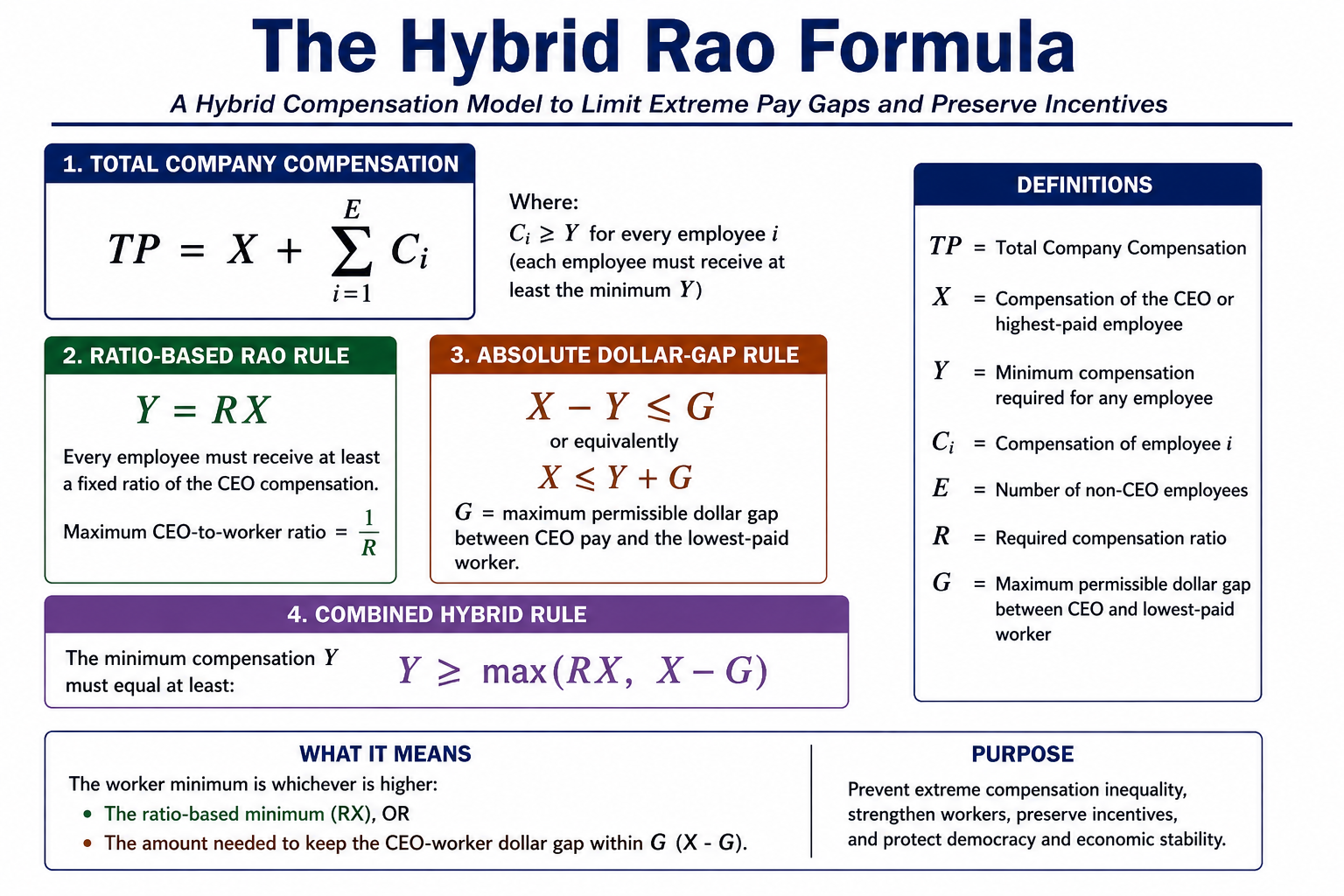
EXPLANATION OF THE NEW HYBRID RAO’s SOLUTION FORMULA FOR FAIRER PAY
(A Revolution in Fairer Pay)
This formula is the successor to the orignal formula espoused to improve worker pay and stop oligarchy in Rao’s Solution, a novel by David Dixon Lentz (2016). [Rao’s Solution can be purchased through links available on this site.} When the novel was written (2014 to 2016), the author did not realistically expect to develop a comprehensive formula that would satisfactorily cover small, medium. large and extremely large (multi-national) companies. The novel itself was designed to get across the simple idea that worker pay should be more closely tied to what CEOs get to reduce wealth inequality, improve worker pay and to inhibit, if not stop, the rise of oligarchy which would essentially kill democracy. This brand new Hybrid formula ( developed circa May 15, 2026), while also incorporating as an integral part thereof Rao’s original formula, was/is intended to cover a much wider range of, if not all, companies. (The novel itself, however, notes that it may be wise to exempt extremely small companies from the requirements of Rao.)
If you want to learn more aboout Rao’s Solution and/or purchase same CLICK the link below or see other articles on this website.
Explanation of the “Hybrid Rao Formula” (prepared largely by ChatGPT)
Rao’s Hybrid Compensation Formula: A Proposal to Reduce Extreme Pay Inequality Without Destroying Incentives
One of the great economic and political dangers facing America is the rise of extreme compensation inequality.
When a tiny number of executives can accumulate extraordinary wealth while millions of workers struggle to afford housing, healthcare, retirement, and family formation, the consequences are serious:
• widening wealth inequality,
• declining birth rates,
• pressure on Social Security,
• weakened economic mobility,
• and the growth of oligarchic political power.
Rao’s Solution is an attempt to address that problem.
But it is not an attempt to impose economic sameness.
Workers should be rewarded differently based upon:
• skill,
• training,
• productivity,
• innovation,
• responsibility,
• experience,
• and performance.
The challenge is finding a system that preserves legitimate incentives while preventing compensation from becoming socially destructive.
The Original Rao Formula
The original formula required every employee to receive compensation equal to at least a fixed percentage of CEO compensation.
That worked mathematically, but two practical problems became apparent:
Problem #1: The “Excess Pay” Problem
If a company paid ordinary workers more than the required minimum, every extra dollar paid to workers reduced the amount available for CEO compensation.
That created pressure toward overly compressed compensation structures.
Problem #2: The Scaling Problem
A compensation rule that may work for a 50-person company may become impractical for a company with 500,000 or 2 million employees.
Large organizations naturally require many compensation levels.
The Hybrid Rao Solution
The Hybrid Rao Formula attempts to solve both problems.
It combines:
1. A Ratio Rule
Every worker must receive compensation tied to CEO compensation.
This prevents extreme CEO-to-worker disparities.
2. A Dollar-Gap Rule
Even where ratios become less practical in giant companies, the law would still prevent the CEO from receiving compensation that exceeds the lowest-paid worker’s compensation by more than a specified dollar amount.
In Plain English
The Hybrid Rao Formula says:
Workers must receive fair compensation, CEOs may still earn more, excellence may still be rewarded—but no compensation structure should become so extreme that it threatens democracy, family formation, or long-term economic stability.
This is not socialism.
This is not communism.
This is a market-based anti-oligarchy proposal designed to preserve incentives while preventing compensation excesses that damage the country.
The goal is simple:
Reward success.
Protect workers.
Preserve opportunity.
Prevent oligarchy.
A PLAIN LANGUAGE DRAFT STATUTE
Here’s the a simplified plain language version of above formulas if put into statuory form:
THE RAO FAIR COMPENSATION ACT
A Proposal to Reduce Extreme Compensation Inequality While Preserving Incentives and Economic Freedom
Section 1. Short Title
This Act shall be known and may be cited as the “Rao Fair Compensation Act.”
Section 2. Legislative Findings and Purpose
Congress finds that:
(a) extreme compensation inequality contributes to destructive concentrations of wealth and political influence inconsistent with democratic self-government;
(b) excessive compensation disparities between senior executives and ordinary workers contribute to economic instability, weakened family formation, declining birth rates, diminished social mobility, and increased pressure on public retirement systems including Social Security;
(c) a free-market economy should preserve incentives for skill, innovation, leadership, productivity, training, and exceptional performance;
(d) compensation systems should reward excellence without permitting compensation structures so extreme that they undermine economic fairness, democratic institutions, or long-term national stability.
Accordingly, the purpose of this Act is to:
reduce extreme compensation inequality;
preserve legitimate economic incentives;
strengthen worker compensation;
discourage oligarchic wealth concentration;
and promote long-term economic and social stability.
Section 3. Definitions
For purposes of this Act:
(a) “Compensation” means any form of economic value received in exchange for services rendered, including but not limited to:
salary,
wages,
commissions,
bonuses,
deferred compensation,
stock,
stock options,
restricted stock units,
stock purchase rights,
partnership distributions attributable to services,
incentive compensation,
severance compensation,
retirement compensation attributable to services,
and any other economic benefit received as compensation.
(b) “Covered Employer” means any corporation, partnership, limited liability company, publicly traded company, privately held business entity, or other employing enterprise subject to this Act.
(c) “Highest-Paid Employee” means the individual receiving the greatest total compensation from the Covered Employer during the applicable compensation year.
(d) “Employee” means any individual providing services to the Covered Employer in exchange for compensation, whether full-time, part-time, temporary, executive, managerial, supervisory, professional, or otherwise, excluding the Highest-Paid Employee.
(e) “Total Company Compensation” (TP) means the aggregate total compensation paid or payable by the Covered Employer during the applicable compensation year.
(f) “Required Compensation Ratio” (R) means the statutory ratio used to establish minimum employee compensation.
(g) “Maximum Dollar Compensation Gap” (G) means the maximum permissible difference between compensation paid to the Highest-Paid Employee and the minimum compensation paid to any Employee.
Section 4. Hybrid Compensation Standard
No Covered Employer shall compensate its Highest-Paid Employee in a manner inconsistent with the Hybrid Rao Compensation Standard.
(a) Ratio Rule
Minimum employee compensation shall be determined, in part, by the Required Compensation Ratio.
The minimum employee compensation under the ratio rule shall be:
Y = RX
Where:
Y = minimum employee compensation
R = Required Compensation Ratio
X = compensation of the Highest-Paid Employee
(b) Dollar-Gap Rule
No Covered Employer shall compensate its Highest-Paid Employee in a manner that causes the compensation difference between the Highest-Paid Employee and the lowest-paid Employee to exceed the Maximum Dollar Compensation Gap.
Thus:
X − Y ≤ G
or:
X ≤ Y + G
(c) Hybrid Rule
The lawful minimum employee compensation shall be the greater of:
(1) the compensation required under the Ratio Rule; or
(2) the compensation necessary to satisfy the Dollar-Gap Rule.
Thus:
Y ≥ MAX(RX, X − G)
Section 5. Compensation Allocation
Total Company Compensation shall be deemed to equal:
TP = X + the total compensation of all other employees
Thus:
TP = X + (C1 + C2 + C3 … through CE)
Where:
Ci represents the compensation paid to each employee; each Ci must be equal to or greater than the required minimum employee compensation.
Section 6. Policy Construction
Nothing in this Act shall be construed to:
require equal compensation among employees;
prohibit compensation differentials based upon skill, training, experience, productivity, leadership, responsibility, innovation, or performance;
prohibit lawful incentive compensation;
or impose economic uniformity.
The purpose of this Act is to prevent extreme compensation inequality, not legitimate compensation differentiation.
Section 7. Enforcement
Congress or the appropriate regulatory authority shall establish:
reporting requirements,
compensation disclosure rules,
audit procedures,
anti-evasion provisions,
and civil penalties sufficient to enforce this Act.
Section 8. Statement of Principle
This Act recognizes that a free society may reward success.
It rejects only compensation structures so extreme that they undermine economic fairness, democratic self-government, family formation, and national stability.
Statutes need to be drafted for part-time and hourly workers and for counting fringe benefits. Other modification, like the phasing in the statute over a few years to lessen economic shock also need to be drafted.