ANALYSIS and OPINION
Trump’s Removal of Officials and Inspectors General from Independent Federal Agencies
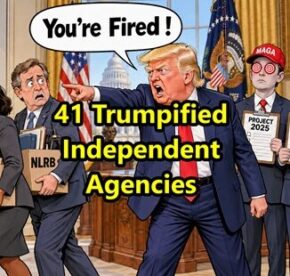
[Editor’s Note: 41 Agencies and 17 Inspectors General were removed and replaced with Trump loyalists.]
A summary of the agencies affected and the officials removed since January 20, 2025
Updated September 11, 2026 | Reason & Balance
Since returning to office on January 20, 2025, President Donald Trump has removed—or purported to remove—members of numerous federal agencies whose staggered terms, bipartisan composition, or statutory removal protections were intended to provide some independence from direct White House control.
The important distinction is that a president ordinarily may designate a new chairperson while leaving that person in place as a commissioner or board member. Trump frequently went further: he removed the person from the commission altogether, before the member’s term expired.
There is no single universally accepted list because federal law uses several different forms of agency independence. The following are the principal, well-documented cases involving independent regulatory agencies, oversight bodies, and congressionally insulated boards.
[Editor’s Note: “These firings were consistent with Project 2025’s plan to increase presidential control over independent agencies—a plan Trump claimed during the 2024 campaign that he knew nothing about.” It is our strong opinion that this was/is but one in a series of major steps of a planned right wing take over of the U.S. government lead by Donald Trump. ]
[Editor’s Note 2: In addition to the political divisiveness and the great potential for unfairness of Trump’s actions, another big concern is that Trump has had an extensive history of hiring/appointing unqualfied incompetent people to fill top posts in his government. Too often, Trump hires/appoints people to critically important top jobs based merely upon their loyalty to him and not upon their expertise or job qualfications.]
Principal independent agencies affected
National Labor Relations Board (NLRB)
Officials affected: Gwynne Wilcox, board member; Jennifer Abruzzo, general counsel
Wilcox and Abruzzo were fired on January 27, 2025. Wilcox was the first NLRB member ever removed by a president, and her removal deprived the board of a quorum. The National Labor Relations Act had limited removal of a board member to neglect of duty or malfeasance after notice and a hearing.
Source: Foley Hoag account
Equal Employment Opportunity Commission (EEOC)
Officials affected: Charlotte Burrows and Jocelyn Samuels
Both Democratic commissioners were fired on January 27, 2025, years before their staggered terms ended. The removals were unprecedented in the EEOC’s history and left the commission without the votes needed for certain actions.
Source: Foley Hoag account
Privacy and Civil Liberties Oversight Board (PCLOB)
Officials affected: Chair Sharon Bradford Franklin, Edward Felten, and Travis LeBlanc
All three Democratic members were fired in January 2025, leaving only one member and no quorum. The board monitors whether federal counterterrorism and surveillance programs respect privacy and civil liberties.
Source: EPIC account
Consumer Financial Protection Bureau (CFPB)
Officials affected: Director Rohit Chopra
Chopra was fired February 1, 2025, before his five-year term expired. Unlike several other cases, existing Supreme Court precedent already permitted a president to remove the CFPB’s single director.
Source: Associated Press report
Federal Election Commission (FEC)
Officials affected: Chair and Commissioner Ellen Weintraub
Trump purported to fire Weintraub on February 6, 2025. She maintained that a president could replace her only by nominating and obtaining Senate confirmation of a successor. The FEC subsequently treated her position as vacant.
Source: Reuters report
U.S. Office of Special Counsel (OSC)
Officials affected: Special Counsel Hampton Dellinger
Dellinger was fired February 7, 2025. He initially won reinstatement, but an appellate stay allowed the firing to take effect, and he discontinued his lawsuit. The OSC protects federal whistleblowers, prosecutes prohibited personnel practices, and enforces the Hatch Act.
Source: Reuters report
Merit Systems Protection Board (MSPB)
Officials affected: Chair Cathy Harris
Harris was fired in February 2025 despite a statute permitting removal only for inefficiency, neglect of duty, or malfeasance. Her removal and Wilcox’s became the principal early Supreme Court test cases concerning presidential removal power.
Source: Associated Press report
Federal Labor Relations Authority (FLRA)
Officials affected: Chair Susan Tsui Grundmann
Grundmann was fired in February 2025 before her term expired. The FLRA administers federal-sector labor-relations law for more than two million federal employees.
Source: Government Executive report
Federal Trade Commission (FTC)
Officials affected: Rebecca Kelly Slaughter and Alvaro Bedoya
Both Democratic commissioners were fired March 18, 2025, without allegations of inefficiency, neglect, or malfeasance. Slaughter’s lawsuit ultimately produced the major 2026 Supreme Court decision expanding presidential removal power.
Source: Reuters report
National Credit Union Administration (NCUA)
Officials affected: Former chair Todd Harper and Tanya Otsuka
Both were fired April 16, 2025, leaving a single Republican member to run the three-member financial regulator. These were the first midterm removals since the modern board was created in 1978.
Source: National Mortgage News account
Consumer Product Safety Commission (CPSC)
Officials affected: Former chair Alexander Hoehn-Saric, Mary Boyle, and Richard Trumka Jr.
All three Democratic commissioners were fired in May 2025. A district court reinstated them, but the Supreme Court allowed the removals to take effect while litigation continued.
Source: Associated Press report
National Transportation Safety Board (NTSB)
Officials affected: Vice Chair Alvin Brown and, later, Todd Inman
Brown was fired in May 2025 without an initially stated reason. Inman, a Republican who had served in Trump’s first administration, was fired in March 2026. The White House later alleged misconduct, which Inman denied.
Source: CBS report on Brown; Reuters report on Inman
Nuclear Regulatory Commission (NRC)
Officials affected: Former chair Christopher Hanson
Hanson was fired June 13, 2025, without stated cause, even though his term extended until 2029. Congress created the NRC in 1974 to make nuclear-safety decisions insulated from ordinary political pressure.
Source: NPR report
Puerto Rico Financial Oversight and Management Board
Officials affected: Chair Arthur González, Cameron McKenzie, Betty Rosa, Juan Sabater, Luis Ubiñas, and later Andrew Biggs
Trump dismissed five of seven members in August 2025 and subsequently removed Biggs, leaving only one member. PROMESA provides that board members may be removed only for cause.
Source: Associated Press report
Surface Transportation Board (STB)
Officials affected: Former chair Robert Primus
Primus was fired in August 2025 while the freight-rail regulator was considering major railroad matters, including the proposed Union Pacific–Norfolk Southern merger. The White House said he did not align with Trump’s “America First” agenda.
Source: CBS report
Federal Reserve Board
Officials affected: Governor Lisa Cook — attempted removal
Trump attempted to fire Cook in August 2025, citing alleged mortgage irregularities. The Supreme Court ultimately kept her in office, holding that Trump had not satisfied the Federal Reserve Act’s “for cause” and due-process requirements.
Source: Supreme Court opinion in Trump v. Cook
National Mediation Board (NMB)
Officials affected: Deirdre Hamilton
Hamilton was fired in October 2025 before expiration of her term. The NMB mediates labor disputes in the railroad and airline industries.
Source: Railway Age report
National Science Board (NSB)
Officials affected: All 22 remaining members, including acting chair Victor McCrary and vice chair Aaron Dominguez
On April 24, 2026, Trump fired the entire independent board that helps govern the National Science Foundation and advises Congress and the president on science and engineering policy.
Source: Nature report; Senate Commerce Committee letter
Election Assistance Commission (EAC)
Officials affected: Chair Thomas Hicks and Benjamin Hovland; Republican Christy McCormick was permitted to resign
Trump removed the two Democratic commissioners on July 9, 2026. McCormick resigned at the same time, leaving the agency with no commissioners only months before the midterm election.
Source: ProPublica report
Independent or quasi-independent organizations also targeted
Corporation for Public Broadcasting (CPB)
Trump attempted to fire directors Thomas Rothman, Laura Ross, and Diane Kaplan in April 2025. CPB maintained that the president lacked removal authority because it is a private nonprofit corporation expressly intended to be free from governmental control.
Source: Reuters report
United States Institute of Peace (USIP)
Trump fired most of its appointed directors and removed board president George Moose. A district judge ruled the takeover unlawful, although subsequent appellate proceedings complicated the result.
Source: Associated Press report
Inter-American Foundation (IAF)
Trump removed all incumbent board members. A subsequent Trump-installed official attempted to fire President and CEO Sara Aviel, and courts disputed whether the replacement was lawfully appointed.
Source: D.C. Circuit order
U.S. African Development Foundation (USADF)
The administration removed the foundation’s board members, including Ward Brehm, and attempted to install Peter Marocco as its leader without Senate confirmation.
Source: Associated Press report
Federal Energy Regulatory Commission (FERC)
Democratic Commissioner Willie Phillips was not formally fired, but he resigned in April 2025 after the White House asked him to leave—more than a year before his term was scheduled to expire.
Source: Politico report
Inspectors general: a separate category
Trump also fired approximately 17 inspectors general in January 2025. They were independent watchdogs located inside departments and agencies—not commissioners of independent agencies—so they should be treated as a separate category. Federal law required advance notice and case-specific reasons to Congress; a federal judge later concluded that the firings violated those procedural requirements, although she declined to reinstate the inspectors general.
Source: Associated Press report
The legal significance
This was not merely the customary replacement of agency chairpersons. Trump repeatedly removed sitting, Senate-confirmed members from their underlying offices during fixed terms. The result was that several commissions lost their bipartisan balance or their quorum and were temporarily unable to perform important statutory functions.
In Trump v. Slaughter, decided June 29, 2026, the Supreme Court largely approved presidential control over these agencies and overruled the 90-year-old protection recognized in Humphrey’s Executor v. United States. The Court nevertheless treated the Federal Reserve differently in Trump v. Cook and prevented Lisa Cook’s removal.
Decisions: Trump v. Slaughter; Trump v. Cook
Conclusion
The cumulative effect has been a fundamental change in the relationship between the president and federal agencies that Congress had designed to possess a degree of independence. Whatever one thinks of the policy merits, the removals substantially increased direct presidential control over labor law, consumer protection, civil-service adjudication, financial regulation, transportation safety, nuclear safety, scientific research, and election administration.