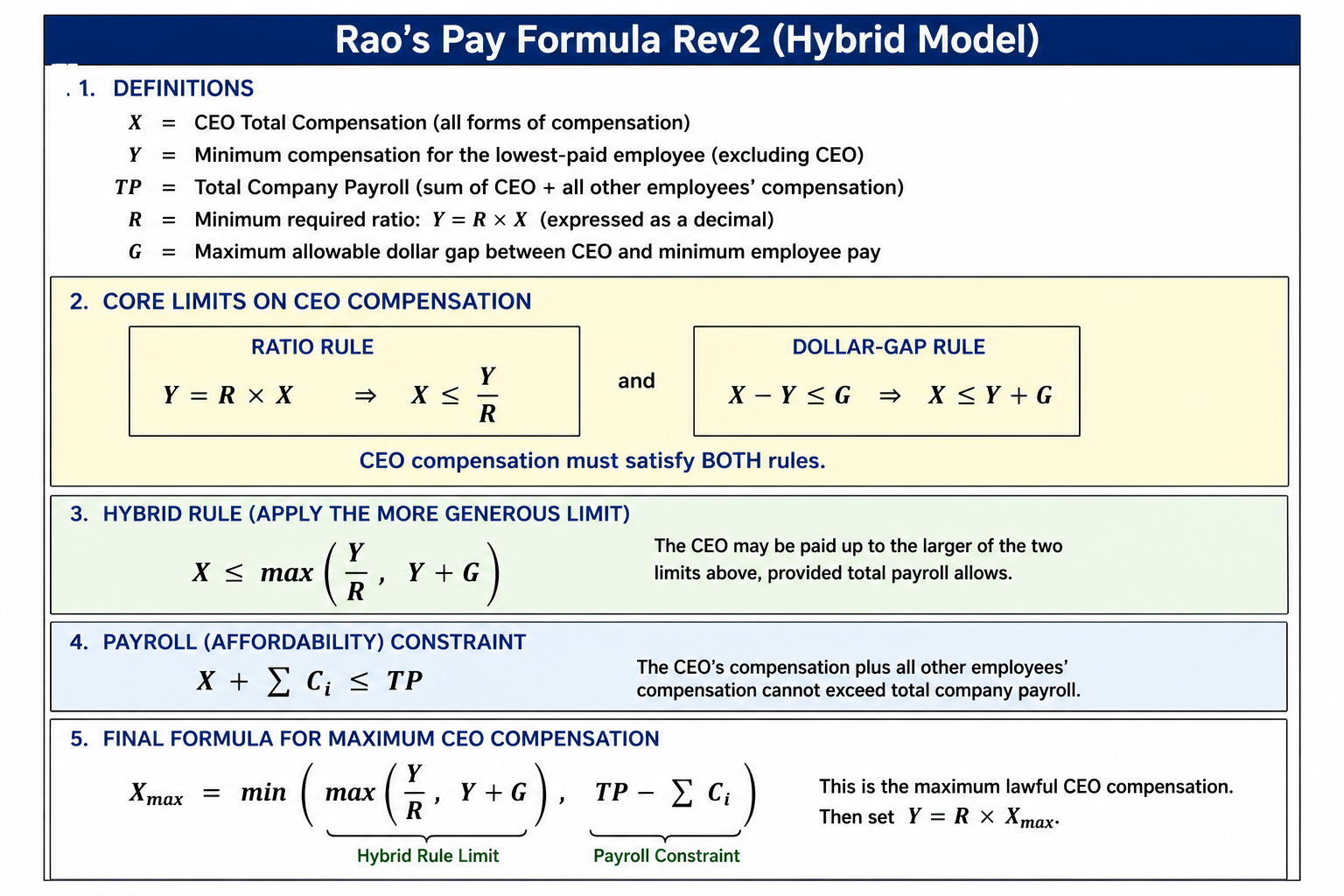
EXPLANATION OF RAO’S PAY FORMULA REV2
A Revolution in Fairer Pay.
(Our video on this topic is at the bottom of this page.)
This formula is the successor to the orignal formula espoused to improve worker pay and stop oligarchy in Rao’s Solution, a novel by David Dixon Lentz (2016). [Rao’s Solution can be purchased through links available on this site.} When the novel was written (2014 to 2016), the author did not realistically expect to develop a comprehensive formula that would satisfactorily cover small, medium. large and extremely large (multi-national) companies. The novel itself was designed to get across the simple idea that worker pay should be more closely tied to what CEOs get to reduce wealth inequality, improve worker pay and to inhibit, if not stop, the rise of oligarchy which would essentially kill democracy. It may well also induce more younger couples to have babies, which would: (i) held the worker/retiree ration which would improve the financial health of social security; and (ii) help alleviate serious issues related to population decline and/or the now urgent need for more immigration. This brand new Hybrid formula ( developed circa May 15, 2026), while also incorporating as an integral part thereof Rao’s original formula, was/is intended to cover a much wider range of, if not all, companies. (The novel itself, however, notes that it may be wise to exempt extremely small companies from the requirements of Rao.)
If you want to learn more aboout Rao’s Solution and/or purchase same CLICK the link below or see other articles on this website.
What Rao’s Pay Formula Rev2 Does
Rao’s Pay Formula Rev2 is a proposed compensation framework designed to reduce extreme CEO-worker pay inequality while preserving economic incentives, private ownership, and free-market competition.
The formula does not require equal pay.
It does not prohibit companies from rewarding excellence, innovation, responsibility, leadership, or special skill.
Instead, it establishes reasonable guardrails so that compensation systems do not become so extreme that they damage workers, families, economic stability, and democracy itself.
The formula works by applying three simple principles:
1. A Minimum Worker Compensation Rule
Every worker must receive at least a minimum compensation amount tied to CEO compensation.
Example:
If the law requires that workers receive at least 1% of CEO compensation, then a CEO earning $10 million would require a minimum worker compensation floor of $100,000.
This prevents the lowest-paid workers from being economically left behind while executives accumulate extraordinary wealth.
2. A Maximum Dollar Gap Rule
The law can also establish a maximum permissible dollar difference between CEO compensation and the compensation of the lowest-paid employee.
Example:
If the maximum dollar gap were set at $8 million, and the lowest-paid worker earned $100,000, then the CEO could not earn more than $8.1 million.
This directly addresses excessive compensation inequality.
3. A Real-World Payroll Constraint
No formula should allow mathematically impossible results.
Accordingly, CEO compensation can never exceed what the company can actually afford after paying its workers.
This prevents accounting games and ensures economic realism.
The Formula’s Purpose
Rao’s Pay Formula Rev2 seeks to:
• reduce extreme compensation inequality;
• strengthen worker compensation;
• support family formation and economic security;
• preserve incentives for excellence and innovation;
• discourage dangerous concentrations of wealth and political power;
• and protect long-term democratic and economic stability.
This proposal is not anti-capitalist.
It preserves:
• private ownership,
• profit,
• competition,
• merit-based compensation,
• executive incentives,
• stock compensation,
• and employee ownership participation.
It simply rejects compensation systems so extreme that they create oligarchic concentrations of wealth while ordinary workers struggle to build stable lives.
In simple terms:
If a company wants extraordinary CEO compensation, it should also be prepared to compensate workers fairly or improve its economic performance accordingly.
PROPOSED IMPLEMENTING STATUTE
THE RAO FAIR COMPENSATION ACT (REV2 Alt)
A Proposal to Reduce Extreme Compensation Inequality While Preserving Incentives, Economic Freedom, and Democratic Stability
Section 1. Short Title
This Act shall be known and may be cited as the “Rao Fair Compensation Act.”
Section 2. Legislative Findings and Purpose
Congress finds that:
(a) extreme compensation inequality contributes to destructive concentrations of wealth and political influence inconsistent with democratic self-government;
(b) excessive disparities between executive compensation and worker compensation contribute to economic insecurity, weakened family formation, declining birth rates, diminished social mobility, and increased long-term pressure on public retirement systems;
(c) a free-market economy should preserve incentives for leadership, innovation, productivity, exceptional performance, training, and responsibility;
(d) compensation systems should reward merit without permitting compensation structures so extreme that they undermine economic fairness, democratic institutions, and long-term national stability.
Accordingly, the purposes of this Act are to:
reduce extreme compensation inequality;
strengthen worker compensation;
preserve legitimate economic incentives;
encourage broader economic participation;
discourage oligarchic wealth concentration;
and promote long-term economic and democratic stability.
Section 3. Definitions
For purposes of this Act:
(a) “Compensation” means any economic value received in exchange for services rendered, including but not limited to salary, wages, commissions, bonuses, deferred compensation, stock, stock options, restricted stock units, stock purchase rights, partnership interests attributable to services, profit-sharing compensation, retirement compensation attributable to services, severance compensation, and any other economic benefit received as compensation.
(b) “Covered Employer” means any corporation, partnership, limited liability company, publicly traded company, privately held business entity, or other employing enterprise subject to this Act.
(c) “Highest-Paid Employee” means the individual receiving the greatest total compensation from the Covered Employer during the applicable compensation year.
(d) “Employee” means any individual providing services to the Covered Employer in exchange for compensation, excluding the Highest-Paid Employee.
(e) “Total Company Payroll” or “TP” means the aggregate compensation paid or payable by the Covered Employer during the applicable compensation year to the Highest-Paid Employee and all other employees.
(f) “Minimum Compensation Floor” or “Y” means the minimum compensation required for any employee.
(g) “Required Compensation Ratio” or “R” means the statutory percentage of Highest-Paid Employee compensation required to determine the minimum compensation floor.
(h) “Maximum Dollar Gap” or “G” means the maximum permissible difference between Highest-Paid Employee compensation and the compensation of the lowest-paid employee.
Section 4. Minimum Compensation Requirement
Every Covered Employer shall compensate each employee at no less than the Minimum Compensation Floor.
The Minimum Compensation Floor shall be:
Y = R × X
Where:
Y = minimum employee compensation
R = statutory compensation ratio
X = compensation of the Highest-Paid Employee
Section 5. Maximum Dollar Gap Requirement
No Covered Employer shall compensate its Highest-Paid Employee in a manner causing the compensation difference between the Highest-Paid Employee and the lowest-paid employee to exceed the Maximum Dollar Gap.
Thus:
X − Y ≤ G
or equivalently:
X ≤ Y + G
Section 6. Payroll Affordability Constraint
No Covered Employer shall pay compensation in excess of its Total Company Payroll.
Thus:
X + ΣCi ≤ TP
Where:
Ci represents compensation paid to each non-CEO employee.
Section 7. Maximum Lawful Executive Compensation
The maximum lawful compensation of the Highest-Paid Employee shall be:
Xmax = min ( max ( Y/R , Y + G ), TP − ΣCi )
Where:
the ratio rule establishes one compensation limit;
the dollar-gap rule establishes a second compensation limit;
the greater of those two limits shall apply;
provided, however, that executive compensation shall never exceed the amount economically supportable within Total Company Payroll.
Section 8. Construction
Nothing in this Act shall be construed to:
require equal compensation among employees;
prohibit compensation differentials based upon merit, training, innovation, productivity, experience, responsibility, leadership, or performance;
prohibit executive incentive compensation;
prohibit employee stock ownership or stock-based compensation;
or prohibit lawful profit-making.
Section 9. Enforcement
Congress or the appropriate regulatory authority shall establish:
reporting requirements;
compensation disclosure rules;
audit procedures;
anti-evasion provisions;
civil enforcement mechanisms;
and penalties sufficient to enforce this Act.
Section 10. Statement of Principle
This Act preserves capitalism, competition, and economic incentives.
It rejects only compensation structures so extreme that they undermine economic fairness, family formation, democratic self-government, and long-term national stability.
Statutes need to be drafted for part-time and hourly workers and for counting fringe benefits. Other modification, like the phasing in the statute over a few years to lessen economic shock also need to be drafted.